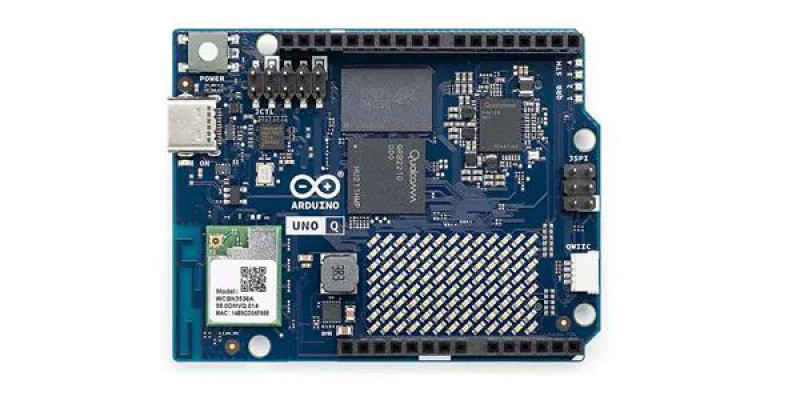
Arduino's new UNO Q is one of the biggest shifts the UNO lineup has seen in years. Instead of being only a microcontroller board, the UNO Q combines two processors on one PCB: a Qualcomm Dragonwing QRB2210 running Debian Linux, and an STM32U585 microcontroller for real-time control.
That hybrid setup means you can run Linux-side tasks like higher-level app logic, networking, and AI inference, while still using the MCU for deterministic hardware jobs such as sensor timing and motor control.
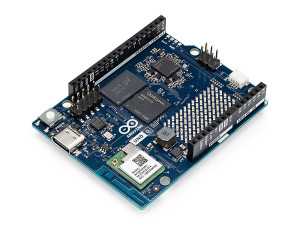
Arduino launched UNO Q in early October 2025, and on January 20, 2026, introduced a higher-spec model with 4GB LPDDR4 RAM and 32GB eMMC storage.
The original 2GB model is still available, but the new 4GB version is designed for heavier workloads, especially when using the board in standalone SBC mode with a monitor, keyboard, and mouse connected through USB-C.
According to Arduino, the extra memory is mainly aimed at multitasking and larger edge AI models, while the larger onboard storage helps when installing more Linux packages or logging project data over longer periods.
Specs
From Arduino's official tech specs, UNO Q includes:
- Qualcomm Dragonwing QRB2210 (quad-core Arm Cortex-A53 at 2.0GHz)
- STM32U585 microcontroller (Cortex-M33 up to 160MHz)
- Wi-Fi 5 dual-band and Bluetooth 5.1
- 8x13 onboard LED matrix
- UNO-compatible headers plus high-speed expansion connectors
This makes UNO Q feel like a bridge between traditional Arduino boards and small Linux computers, while still keeping compatibility with much of the existing UNO ecosystem.
Price
At the time of writing, Arduino lists the 2GB UNO Q at €47.58 and the 4GB version at €64.66 on its official store pages.
If you want a board for classic low-power microcontroller projects, the UNO R4 WiFi is still the simpler route. But if your project needs Linux apps, modern connectivity, and on-device AI in the same footprint, UNO Q is clearly where Arduino is pushing next.