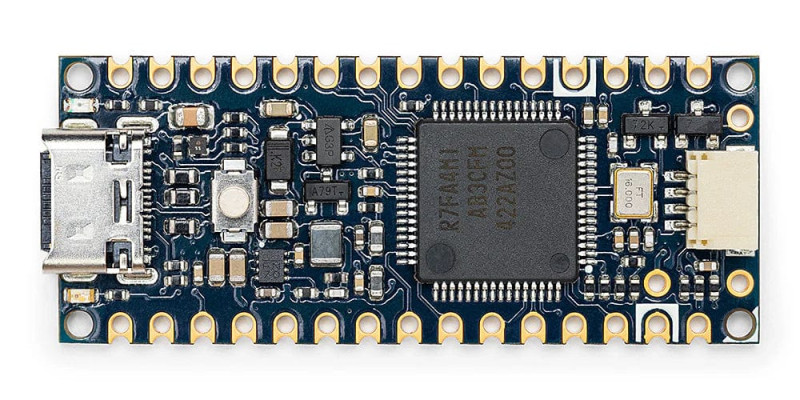
Arduino has expanded its Nano family with the Nano R4, a compact board built around the same Renesas RA4M1 microcontroller used in the UNO R4 lineup.
The board was announced on July 24, 2025 and is aimed at projects that need UNO R4-level performance in a much smaller footprint.
Same Core as UNO R4, Smaller Format
Nano R4 uses a 48MHz Arm Cortex-M4 (RA4M1) with 256KB flash, 32KB SRAM and 8KB EEPROM. It keeps a 5V operating voltage, which is useful for many existing sensors, modules and Nano-compatible accessories.
Compared to older Nano boards, Arduino positions the R4 as a more production-ready option thanks to its compact 45 x 18mm layout, castellated pins, and single-sided component placement for easier integration onto custom PCBs.
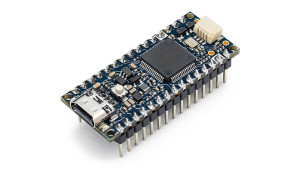
Arduino is selling two variants: a standard Nano R4 and a version with pre-soldered headers.
Despite its size, Nano R4 includes several features usually found on larger boards:
- USB-C programming port
- CAN support (with external transceiver)
- Built-in Qwiic I2C connector (3.3V) plus a separate 5V I2C interface
- Onboard 12-bit DAC and integrated op-amp support
That combination makes it a flexible fit for compact robotics, automation nodes, data logging, and low-power edge devices where board space matters.
Price
At the time of writing, Arduino lists Nano R4 at €13.40 on its official store, with a separate priced SKU for the pre-header version.
If you are already prototyping on UNO R4 and need to shrink your final design, Nano R4 looks like the natural migration path without a full platform rewrite.